From the Margins to the Marquee: How Background Actors Are Charting a New Course to Leading Roles
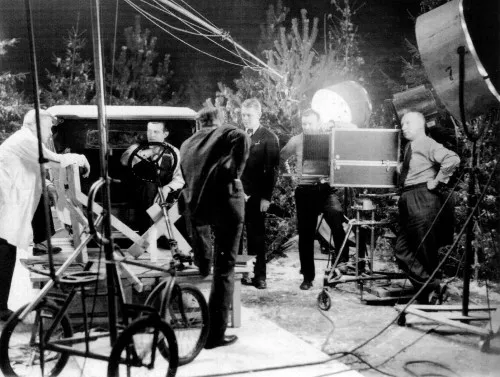
Photo: Kansallinen audiovisuaalinen arkisto (Nation Audiovisual Archive), Public domain, via Wikimedia Commons
For decades, the entertainment industry maintained a largely invisible boundary between those who populated a scene's edges and those who defined its emotional core. Background work — the craft of breathing life into a diner, a busy street corner, or a crowded courtroom without ever speaking a line — was widely regarded as a staging ground with no forward exit. That perception, it turns out, was always more myth than reality. Today, a confluence of strategic networking, shifting casting practices, and the expansive appetite of streaming platforms is quietly dismantling that boundary, one booking at a time.
The Set as a Classroom — and a Stage
Experienced casting directors are among the first to acknowledge that background work, when approached with intention, functions as something far more valuable than a résumé line. "What we often see is that the actors who transition successfully from background to principal roles are the ones who treat every day on set as an audition — not in a performative way, but in terms of professionalism and presence," notes one veteran casting director based in Los Angeles who has worked across both studio features and independent productions.
That distinction matters. Directors, first assistant directors, and producers move fluidly across a working set, and their observations extend beyond the primary actors on their call sheets. A background player who arrives prepared, understands blocking intuitively, and responds organically to shifting scene dynamics registers — even when no one appears to be watching. Over time, those observations accumulate into a form of informal reputation that can precede a formal audition.
Several recent productions have illustrated this dynamic in concrete terms. On a mid-budget independent film shot in Atlanta — a city that has become one of the country's most active production hubs — a background actor was upgraded to a speaking role mid-shoot after a director noticed the specificity of the actor's physical choices during a crowd sequence. That upgrade led to a relationship with the production's casting team, which ultimately resulted in a principal audition for the director's subsequent project.
Networking Below the Line — and Why It Works
Much of the conventional wisdom around Hollywood networking focuses on actor-to-actor or actor-to-agent relationships. What is less frequently discussed is the strategic value of cultivating connections with crew members — the cinematographers, script supervisors, assistant directors, and production coordinators who form the operational backbone of any production.
These relationships carry weight for a straightforward reason: crew members frequently move from project to project ahead of casting decisions, and their informal recommendations carry credibility with producers and directors who trust their professional judgment. A background actor who has demonstrated reliability, adaptability, and genuine craft on a previous project may find themselves mentioned in a conversation that precedes a formal casting call.
"Crew talk," as one New York-based casting associate describes it. "If a second AD tells me that someone they worked with on a previous show was exceptional — not just fine, but genuinely exceptional — I pay attention to that. It's not a guarantee, but it opens a door."
For background actors seeking to build these relationships authentically, the approach requires patience and a fundamental shift in orientation. The goal is not to engineer visibility but to earn it through consistent, high-quality work and genuine professional engagement.
Streaming's Democratizing Effect on Opportunity
Perhaps the most structurally significant shift in the pathway from background to principal work has been the proliferation of streaming content. The sheer volume of episodic programming produced for platforms such as Netflix, Amazon Prime Video, Apple TV+, Peacock, and their competitors has created an unprecedented demand for actors at every level of experience and recognition.
This demand has had a measurable effect on casting elasticity. Productions that might once have defaulted exclusively to actors with established principal credits are increasingly open to considering performers whose work has been observed firsthand on set — including background players who have distinguished themselves in supporting or atmospheric capacities. Shorter episodic formats, in particular, have created opportunities for smaller speaking roles that serve as effective bridges between background work and more substantial principal engagements.
There is also a content discovery dimension to this shift. Several actors who began in background roles have strategically used self-produced short-form content — distributed through platforms such as YouTube, Instagram, and TikTok — to demonstrate range and attract attention from casting professionals who might not otherwise have encountered their work. This approach represents a meaningful departure from the passive model of background work as a waiting strategy and reframes it as one component within a broader, self-directed career architecture.
The Role of Representation — and Its Limits
Securing theatrical representation remains one of the more durable challenges for actors transitioning out of background work. Many agencies maintain explicit policies against signing actors whose credits are composed primarily of background bookings, which can create a structural catch-22: the visibility needed to attract an agent often requires the kind of principal credits that an agent might help secure.
Several working actors who have navigated this transition successfully describe a similar workaround: pursuing non-union independent productions and student films to accumulate principal credits, then leveraging those credits — alongside set relationships built through background work — to approach boutique agencies or talent managers. The manager relationship, in particular, is often cited as a more accessible first step, given that managers operate under a different regulatory framework than licensed talent agents and are frequently more willing to engage with actors in earlier stages of their careers.
"The path isn't linear, and it rarely follows the script people expect," observes a talent manager who represents several actors who began their professional lives in background work. "But the ones who make it through are almost always the ones who understood that background work was a tool, not a destination."
Craft as Currency
Underlying every successful transition story is a consistent theme: the actors who move from the background to the foreground are those who have invested substantively in their craft independent of their on-set opportunities. Acting classes, improv training, scene study workshops, and dialect coaching all appear with regularity in the backgrounds of those who have made the leap.
This investment serves a dual purpose. It prepares actors for the technical demands of principal work — auditions, chemistry reads, and the collaborative dynamics of working opposite experienced performers — while also signaling to industry professionals that an actor's ambitions and capabilities extend beyond atmospheric presence.
The entertainment landscape is, at its core, a meritocracy shaped by relationships. For background actors willing to engage both dimensions with discipline and authenticity, the margins of a scene are not a ceiling — they are, increasingly, a starting line.