The Quiet Script: How Screenwriters Are Discovering That Silence Speaks Louder Than Dialogue

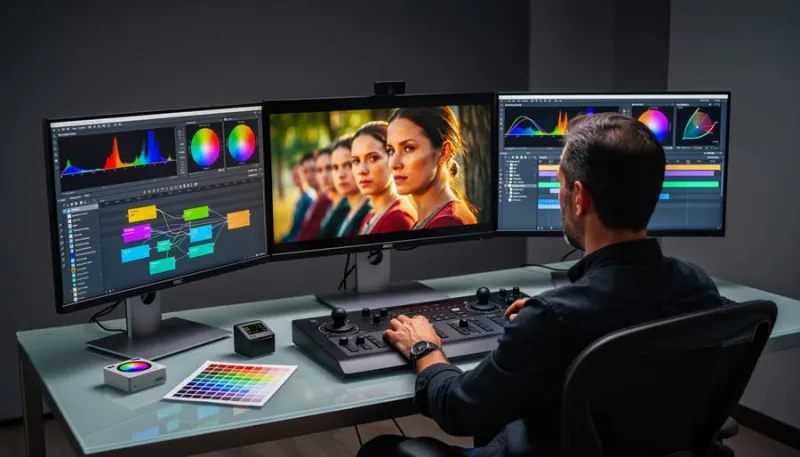
Photo: Vancouver Film School, CC BY 2.0, via Wikimedia Commons
There is a particular kind of courage required to write a blank page. Not the blank page of the unfilled draft, but the intentional one — the scene heading followed by a character's name and nothing beneath it. No lines. No parentheticals. Just the instruction, implicit or explicit, that the camera and the actor must carry the weight alone.
Across Hollywood and the broader American streaming landscape, a growing number of screenwriters are making exactly that choice. In an entertainment culture that often equates productivity with output and output with noise, the deliberate deployment of silence has become one of the more quietly radical creative decisions a writer can make.
Rewriting the First Rule of Screenwriting
Conventional screenwriting pedagogy has long maintained that dialogue serves as the primary vehicle for character revelation and narrative propulsion. The three-act structure, as it has been taught in MFA programs and industry workshops for decades, tends to treat spoken exchange as the engine of dramatic momentum. Characters talk, they reveal, they conflict — and the story moves.
But that framework, some working writers argue, may have always been more prescriptive than descriptive. Films that endure — from the early work of Terrence Malick to the spare, image-driven storytelling of Kelly Reichardt — have consistently demonstrated that the most durable emotional impressions are often made without a single word.
What has changed in the current moment is the scale of that realization. Writers working across prestige drama, independent film, and even mid-budget streaming projects are incorporating extended quiet passages not as stylistic flourish, but as structural strategy. The silence is drafted. It is intentional. And increasingly, it is being recognized by directors and producers as a mark of genuine craft.
The Technical Architecture of Quiet
Writing silence into a screenplay is more technically demanding than it might appear. The challenge is not simply omitting dialogue — it is constructing a visual and behavioral framework specific enough to guide a director and actor while remaining sufficiently open to interpretation.
This requires a writer to think in images with the precision of a cinematographer and in behavior with the empathy of a psychologist. A character who sits at a kitchen table and says nothing must still be doing something. The hand that moves toward a coffee cup and then retreats. The eye that tracks a sound from another room. The stillness itself, calibrated to communicate pressure, grief, or relief depending on the context the writer has constructed in the pages preceding it.
Screenwriters working in this mode often describe the process as one of radical compression. Every visual detail in a quiet scene must earn its presence. There is no dialogue to redirect attention, no spoken subtext to guide the audience's interpretation. The writer must trust the image entirely — and must build that image with enough precision that it functions as intended.
This demands a working relationship with the page that is closer to poetry than prose. Word economy becomes paramount. The action line — that often-neglected strip of descriptive text between dialogue blocks — becomes the primary site of storytelling.
What Audiences Are Actually Watching
The argument for silence is not purely aesthetic. It is, increasingly, an argument grounded in how contemporary American audiences engage with screen content.
Streaming platforms have fundamentally altered viewing behavior. Audiences now watch across devices, in varied environments, with fluctuating levels of attention. The assumption that every viewer is seated in a darkened theater with full concentration is no longer reliable. In response, some writers have moved toward dialogue-heavy scripts — more exposition, more verbal clarity, more redundancy between what is said and what is shown.
But a counter-movement has emerged, one that argues this approach underestimates the audience. Viewers who have grown up consuming film across multiple platforms are, in many respects, more visually literate than any previous generation. They have been trained by decades of visual media to read image, posture, and spatial relationship with considerable sophistication.
Writers working in the silence-forward mode are, in effect, writing for that literacy. They are composing scenes that reward close attention, that offer layered meaning to the viewer willing to sit with an image rather than move past it. It is a form of respect encoded into the script itself.
The Streaming Variable
The relationship between this movement and the streaming ecosystem is not without its complications. Streaming platforms, particularly at the network level, have historically favored scripts with high dialogue density. Notes from development executives frequently push writers toward verbal clarity — toward characters who articulate their motivations, their conflicts, and their emotional states in language that is accessible across a broad demographic range.
This institutional pressure creates a genuine tension for writers committed to visual storytelling. Navigating it requires a particular kind of advocacy — the ability to defend not what is on the page, but what is conspicuously absent from it.
Some writers have found allies in directors and showrunners who share their instincts. Others have learned to annotate their quiet scenes more explicitly in early drafts, providing enough contextual scaffolding that development executives can understand the intent before the visual language of production makes it self-evident.
Subtext as Infrastructure
At the heart of the silence movement is a renewed investment in subtext — the understanding that what characters do not say is frequently more revealing than what they do. This is not a new idea. Playwrights from Harold Pinter to Sam Shepard built entire bodies of work on the architecture of the unspoken. What is new is the degree to which subtext is now being treated as structural infrastructure rather than tonal garnish.
For a screenwriter, building subtext into a quiet scene requires establishing its conditions well in advance. The audience must know enough about a character's history, desire, and fear that a moment of silence lands with the weight of everything that has not been said across the preceding narrative. The silence is not empty — it is full. The writer's task is to fill it before the scene arrives.
This is, ultimately, what separates silence as craft from silence as avoidance. The blank space on the page is not a failure of imagination. It is its most concentrated expression.