Point, Frame, Submit: How the Self-Taped Audition Is Redrawing the Map of American Acting

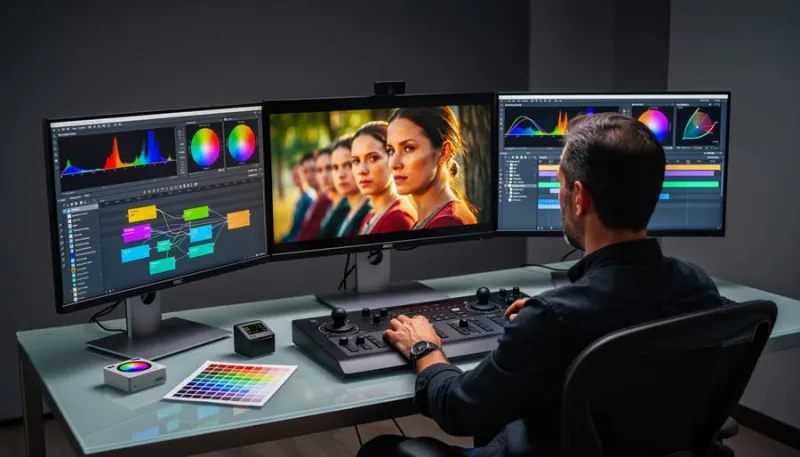
Photo: actor self-taping audition at home with ring light and camera setup, via weareactors.com
For an actor living in Nashville, Albuquerque, or Minneapolis a decade ago, a casting call from a major Los Angeles production company carried a particular kind of arithmetic. Travel cost. Time away from work. The possibility — often the probability — of flying across the country for a three-minute meeting and a flight home with nothing booked. The financial calculus alone placed professional auditions beyond the practical reach of most performers outside the industry's traditional coastal centers.
The self-taped audition has not eliminated that arithmetic entirely. But it has rewritten it in ways that are still reverberating through every level of the American acting profession.
What began as a logistical accommodation — first adopted broadly during the disruptions of 2020, then retained by casting offices that discovered they preferred the format — has become the dominant mode of first-round auditioning across film, television, and streaming. The implications of that shift are not simply logistical. They are geographic, economic, psychological, and, at the deepest level, democratic.
The Geography of Access
Prior to the widespread adoption of self-taping, the American casting ecosystem operated on an implicit assumption: serious professional actors lived in Los Angeles or New York, or were prepared to travel to one of them on short notice. Regional talent existed, was occasionally celebrated, and was sometimes imported for specific projects — but the default infrastructure of professional casting was built around proximity.
Self-taping has disrupted that assumption at the foundational level. An actor in Atlanta, Chicago, or Austin can now respond to a casting notice for a network drama or a major streaming feature within the same submission window as an actor living ten minutes from a casting office in Burbank. The physical distance has been rendered, at least in the submission phase, irrelevant.
For casting directors, this has meant access to a dramatically broader talent pool. Offices that once received submissions from a predictable geographic and representational range are now reviewing work from performers they would never have encountered through traditional channels. The practical effect, reported consistently by industry professionals, is that the quality ceiling of what arrives in the initial review has risen — not because coastal talent has declined, but because the pool now includes performers of equivalent caliber who were previously invisible to the system.
The Technical Threshold
The democratization of access, however, has introduced a new set of barriers to replace the geographic ones it removed. Self-taping is not simply acting in front of a phone camera. It is a technical discipline with its own requirements, and the gap between a submission that reads as professional and one that does not is often not a gap in performance quality — it is a gap in technical execution.
Lighting is the most consequential variable. A performance that would be compelling in a casting room can be rendered unreadable by inadequate or unflattering light. The difference between a ring light positioned correctly and a window source handled poorly is the difference between a tape that gets watched to the end and one that is stopped at the thirty-second mark. Casting directors, reviewing hundreds of submissions for a single role, are making rapid judgments about whether a tape merits sustained attention — and the technical quality of the submission influences that judgment before a single line of dialogue is delivered.
Audio presents a parallel challenge. Background noise, room reverb, and inconsistent recording levels are not merely inconveniences — they are signals that register, consciously or not, as indicators of a performer's professional readiness. An actor who has invested in a basic directional microphone and learned to record in a treated space is communicating something about their seriousness and self-awareness that the performance alone cannot convey.
Framing, backdrop, and reader quality complete the technical picture. Each element contributes to or detracts from the casting director's ability to focus on the performance itself. The goal of technical execution in a self-tape is, paradoxically, invisibility — the complete subordination of the technical apparatus to the work being delivered.
The Psychology of Self-Direction
Beyond the technical requirements, self-taping introduces a psychological challenge that many actors find more demanding than the in-room audition it has largely replaced: the challenge of self-direction.
In a traditional audition setting, the casting director's presence provides immediate feedback — a response to a choice, a request to try something differently, a quality of attention that confirms the performance is being received. The self-taped format eliminates all of that. The actor performs to a reader and a lens, with no confirmation that any choice is landing, no opportunity for real-time adjustment, and no human presence on the other side of the camera whose reactions can be read and responded to.
This demands a quality of self-awareness and self-trust that is distinct from conventional performance technique. The actor must function simultaneously as performer and director — making choices, evaluating them against an internalized standard, and committing to them without external validation. It is a form of creative autonomy that some performers find liberating and others find profoundly destabilizing.
The actors who navigate this challenge most effectively tend to be those who have developed a disciplined pre-tape process: a structured approach to script analysis, choice-making, and technical setup that creates enough internal certainty to perform without the scaffolding of an in-room dynamic.
What Casting Directors Are Actually Evaluating
For the casting professionals on the receiving end of this volume of material, the self-tape era has required its own set of adaptations. The evaluation of a self-taped submission is not identical to the evaluation of an in-room performance, and the most experienced casting directors have developed nuanced frameworks for reading the format.
Beyond performance quality, casting directors report attending closely to evidence of self-direction — the degree to which an actor has made specific, committed, and interesting choices rather than defaulting to the most obvious interpretation of the material. A self-tape that demonstrates genuine interpretive intelligence, even if the technical execution is imperfect, tends to generate more interest than a technically polished tape in which no distinctive choices have been made.
The self-tape also reveals something about an actor's professional infrastructure — their access to coaching, their investment in their own career development, and their capacity for self-advocacy. These are qualities that matter in the professional context of a production, and casting directors are reading for them.
A Permanent Recalibration
The self-taped audition is no longer a contingency measure. It is the standard, and the industry has organized itself around that reality. Talent agencies in secondary markets have expanded. Acting coaches specializing in self-tape technique have built substantial practices. The ecosystem of tools, resources, and professional support that performers need to compete in this format is more developed than it has ever been.
Whether this constitutes a fundamental democratization of Hollywood hiring — or simply a shift in where the barriers to entry are located — remains an open and genuinely contested question. What is not contested is that the map of American acting has been redrawn. The center is no longer the only place from which the work can begin.