Smaller by Design: The Seasoned Crew Members Trading Studio Contracts for Creative Sovereignty
For much of the twentieth century, a career in American film production followed a recognizable arc. You accumulated credits, built relationships, and eventually secured the kind of studio adjacency that provided both financial stability and professional prestige. The system rewarded patience and loyalty. It also, by design, rewarded conformity.
That compact is dissolving. Across the industry, a significant cohort of highly experienced crew members — cinematographers with decades of features behind them, editors whose resumes include awards-season titles, producers who have shepherded nine-figure budgets — are choosing a different path. Rather than competing for studio deals or positioning themselves for the next major network series, they are founding small, tightly structured creative collectives that operate outside the traditional system entirely.
The phenomenon has been described variously as a freelance exodus, a craft renaissance, and a market correction. Whatever label one applies, the trend is substantive, and its implications for how American entertainment content is financed, produced, and distributed are only beginning to come into focus.
The Economics of Departure
The financial logic driving this migration is less counterintuitive than it might initially appear. Studio structures, for all their resource advantages, impose considerable overhead — in the form of development timelines, approval hierarchies, and contractual obligations that frequently dilute both the pace of work and the compensation flowing to individual contributors.
A seasoned cinematographer operating within a boutique collective, by contrast, can negotiate directly with clients, retain a larger share of project revenue, and move between engagements with a speed that the studio calendar cannot accommodate. For professionals whose reputations are sufficiently established to generate inbound interest, the economic case for independence is increasingly compelling.
This calculus has been further influenced by the volatility that has characterized the streaming sector over the past several years. High-profile content investment surges followed by abrupt cancellations and workforce reductions have left many experienced crew members questioning the reliability of institutional affiliations that once seemed permanent. The micro-studio model, whatever its risks, offers a form of diversification that dependence on a single employer cannot.
What a Micro-Studio Actually Looks Like
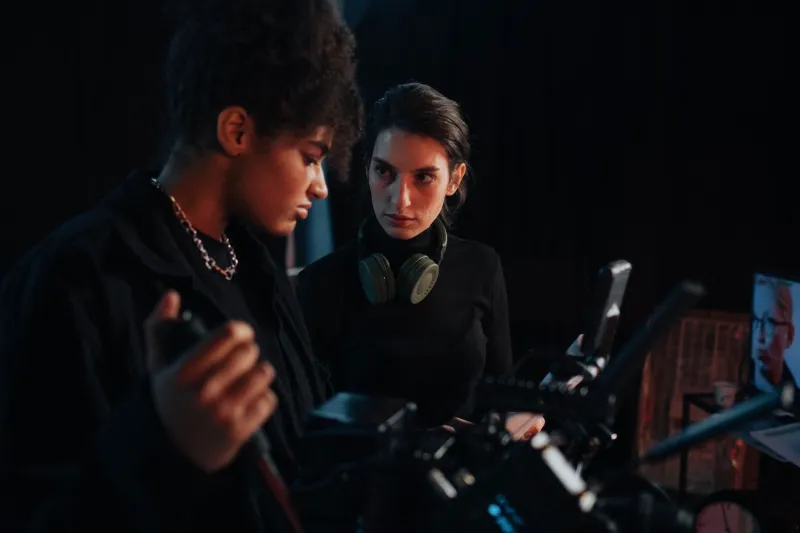
The term micro-studio encompasses a range of organizational models, but certain characteristics recur. These entities are typically small — rarely more than a dozen core collaborators — and deliberately generalist in their capabilities while remaining specialist in their identity. A collective built around a celebrated director of photography, for instance, might include a colorist, a gaffer, a camera operator, and a line producer, each selected for both technical excellence and philosophical alignment.
Project selection is highly intentional. Micro-studios tend to pursue work that offers creative latitude — branded content for clients willing to invest in distinctive visual storytelling, documentary projects with genuine editorial independence, short-form narrative work for platforms that have demonstrated respect for craft. The rejection of volume in favor of selectivity is not merely aesthetic preference; it is a business strategy premised on the idea that reputation, in a fragmented market, is the most durable competitive advantage.
Several such collectives operating out of Los Angeles, New York, and increasingly cities including Atlanta, Austin, and Chicago have begun attracting commissions that would previously have been routed through mid-sized production companies. Their ability to deliver sophisticated work with minimal administrative friction has proven attractive to clients who have grown weary of the inefficiencies embedded in larger organizational structures.
Creative Autonomy as a Recruiting Tool
One of the less-discussed dimensions of the micro-studio trend is its effect on talent recruitment within the industry. Experienced professionals are not the only ones gravitating toward these structures; emerging crew members actively seek out collectives as a career entry point, drawn by the prospect of meaningful collaboration with established practitioners in an environment that does not subordinate craft to institutional priorities.
This dynamic creates a form of apprenticeship that the studio system, with its departmental silos and union-defined boundaries, has historically struggled to replicate. Within a well-functioning micro-studio, a junior editor might observe — and eventually participate in — conversations about project selection, client negotiation, and creative direction that would be inaccessible to them in a conventional employment context. The knowledge transfer is lateral as well as hierarchical, producing professionals whose understanding of the industry is both broader and more practically grounded.
Navigating the Limits of Scale
The micro-studio model is not without its structural vulnerabilities. Collectives that lack the capitalization to absorb extended gaps between projects face genuine financial pressure. Client relationships, however productive, can terminate abruptly. The absence of a development infrastructure means that original IP generation — the long-term asset that sustains larger companies — is difficult to pursue consistently.
Several collectives have addressed these constraints through informal networks of peer organizations, sharing resources, referrals, and occasionally crew across projects without formalizing the arrangement into a merger or acquisition. This kind of loose federation preserves the independence that motivates the model while providing a degree of resilience that isolated entities cannot achieve on their own.
Legal and financial advisors who work with entertainment industry clients report a growing demand for guidance on structuring these arrangements — a practical indicator that the trend has moved well beyond the experimental stage and into the mainstream of how experienced professionals are choosing to organize their working lives.
A Structural Shift, Not a Passing Phase
The micro-studio movement reflects something more fundamental than individual professionals seeking better terms. It represents a structural reconfiguration of how creative expertise is organized and deployed in an industry whose economics have been disrupted more profoundly in the past decade than in the preceding half-century.
The studios and networks that once defined the boundaries of professional ambition remain consequential. Their resources, distribution infrastructure, and brand recognition are not easily replicated. But the monopoly on quality — on the kind of craft-driven, conceptually ambitious work that attracts the industry's best talent — is no longer theirs to claim. The professionals building micro-studios are not abandoning the industry. They are redesigning it, one carefully chosen project at a time.